Arawaks del Clan del Águila
Arawaks del Clan del Águila
The Caribbean Amerindian Development Organization (CADO) is an Indigenous‑led, non‑profit regional body created to advance the rights, cultural continuity, and sustainable development of Indigenous peoples across the Caribbean and its diaspora.
Co‑created by Eagle Clan Lokono‑Arawak faithkeeper Damon Corrie alongside Indigenous leaders from the Taíno and Kalinago nations, CADO functions as the principal regional platform through which members of the Eagle Clan and allied Caribbean Indigenous communities engage publicly with governments, international institutions, and development partners.
Founded in 2012, CADO emerged from long‑standing inter‑Caribbean Indigenous collaboration and a shared recognition that Caribbean Indigenous peoples required a coordinated regional organization capable of addressing common challenges while respecting the sovereignty, diversity, and traditions of each nation.
Operating at both regional and international levels, CADO works to ensure that Indigenous communities participate directly in decision‑making processes that affect their lands, livelihoods, cultures, and futures.
Arawaks del Clan del Águila
CADO’s mission is to support Indigenous self‑determination through advocacy, cooperation, cultural revitalization, and sustainable community development grounded in Indigenous knowledge systems.
Its objectives include:
-
Advancing Indigenous rights under international and regional legal frameworks
-
Supporting Indigenous governance and representation
-
Promoting cultural revitalization, language protection, and heritage preservation
-
Developing sustainable, community‑based economic models
-
Advocating for environmental stewardship and climate justice
-
Supporting disaster preparedness and recovery for Indigenous communities
-
Strengthening regional cooperation among Caribbean Indigenous nations
-
Encouraging youth leadership and intergenerational knowledge transmission
CADO promotes holistic approaches to development rooted in Indigenous philosophies that emphasize balance, reciprocity, long‑term stewardship, and responsibility to future generations.
Arawaks del Clan del Águila
CADO engages actively with Caribbean governments, diplomatic missions, financial institutions, and multilateral bodies in order to elevate Indigenous voices within regional decision‑making spaces.
Its work has included collaboration with institutions such as the Caribbean Development Bank and participation in forums hosted by the Organization of American States, as well as engagement with wider Indigenous development networks throughout Latin America and the Caribbean.
CADO has advocated for the implementation of the United Nations Declaration on the Rights of Indigenous Peoples and the American Declaration on the Rights of Indigenous Peoples, promoted Indigenous participation in community‑based tourism initiatives, and supported disaster‑relief efforts for Indigenous villages affected by hurricanes and climate‑related emergencies.
Through these engagements, CADO seeks to ensure that Indigenous peoples are recognized not only as stakeholders, but as rights‑holders and partners in shaping regional policy and development.

Legal Registration and Institutional Standing
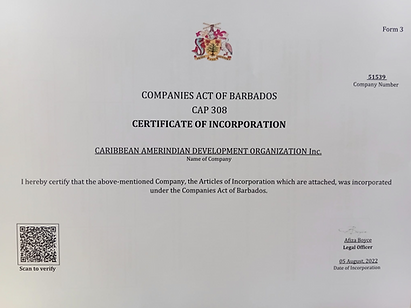
Certificate of Incorporation for the Caribbean Amerindian Development Inc., issued in Barbados in 2022.
QR code included for verification
Arawaks del Clan del Águila
CADO was founded by a gender-balanced Indigenous council representing Lokono, Kalinago, and Taíno communities, reflecting the organization’s commitment to inclusive regional leadership across the Caribbean.
Its current co-presidents include Damon Gerard Corrie (Lokono-Arawak), Sabantho Aderi Corrie-Edghill (Lokono-Arawak), Roberto Mukaro Borrero (Taíno), Tai Migdalia Pelletier (Taíno), Irvince Auguste (Kalinago), and Juliana Glasgow (Kalinago), whose combined experience spans cultural preservation, diplomacy, education, community organizing, advocacy, and Indigenous economic development.
The organization operates through Indigenous-led governance structures and consultative processes designed to remain accountable to the communities it serves. Decision-making is informed through dialogue with elders, youth representatives, village leadership, and regional community networks.

Damon Gerard Corrie (Lokono-Arawak)

Sabantho Aderi Corrie-Edghill
(Lokono-Arawak)

Roberto Mukaro Borrero (Taíno)

Juliana Glasgow (Kalinago)

Irvince Auguste (Kalinago)

Tai Migdalia Pelletier (Taíno)
Arawaks del Clan del Águila
CADO maintains active relationships with Indigenous communities throughout the region through in‑person outreach, consultations, surveys, and digital platforms.
This includes maintaining a public community forum used to gather perspectives, identify priorities, and share information relevant to Indigenous peoples across the Caribbean and the diaspora.
These engagements ensure that CADO’s strategies are shaped by community needs and lived realities rather than imposed from outside, and that its advocacy remains grounded in Indigenous knowledge, experience, and consent.

Arawaks del Clan del Águila
For members of the Eagle Clan Lokono‑Arawaks, CADO represents the principal regional body through which the Clan engages publicly in diplomacy, advocacy, and development work.
Through CADO, Eagle Clan representatives participate in regional negotiations, cultural exchanges, international forums, and development initiatives while remaining rooted in ancestral responsibility, faithkeeping traditions, and intergenerational stewardship.
This relationship reflects continuity between Clan governance and regional Indigenous collaboration, allowing local lineage‑based leadership to operate alongside broader Caribbean Indigenous solidarity.

Arawaks del Clan del Águila
CADO continues to expand its work across the Caribbean in response to climate change, development pressures, cultural loss, and the need for stronger Indigenous participation in regional governance.
Its future priorities include strengthening village‑level sustainability initiatives, expanding youth leadership programs, supporting Indigenous women’s networks, and deepening cooperation with governments and institutions committed to respectful partnership with Indigenous communities.
Through these efforts, CADO remains committed to building futures defined by dignity, resilience, cultural continuity, and Indigenous self‑determination.

Arawaks del Clan del Águila
The Caribbean Amerindian Organisation affirms its steadfast support for our honourable allies, the Accompong Maroons of Jamaica, whose legal claims are well documented and whose rights stand recognised by treaty.


