HISTORY OF THE EAGLE CLAN LOKONO-ARAWAK
This page records the documented history, lineage, and cultural continuity of the Eagle Clan Lokono people, including their ancestral homeland in Guyana and the formation of their modern diaspora across the Caribbean and beyond. It is presented as a cultural and historical archive for future generations.
Who the Lokono Are
Identity, naming, and cultural self-definition
The Lokono are an Arawakan-speaking Indigenous people native to the northern coastal and riverine regions of South America. Today, Lokono communities and descendants are found primarily in Guyana, Suriname, French Guiana, Venezuela, Barbados, and throughout the wider Caribbean diaspora.
The Lokono language is the eponymous language of the Arawakan language family, which at the time of European contact constituted the most widespread linguistic family in the Caribbean and northern South America. While approximately ten thousand Lokono people remain today, only a small minority retain fluency in the language, with most speakers aged fifty and over. The majority of younger Lokono speak English, Dutch, French, or Spanish as a result of colonial and post-colonial education systems in which the Lokono language has never been formally taught.

Names, Identity, and Historical Misclassification
Colonial disruption and Indigenous self-recognition
In their own language, the people call themselves Lokono, meaning “many people.” A single individual is referred to as Loko, while Lokobe refers to “some people” of the same tribe. The name of the language is also Lokono, as in the phrase “Da jiabo Loko,” meaning “I speak the language.”
The term “Arawak” does not exist in the Lokono language. It was applied externally by the Warrau people of the Orinoco Delta, who had early contact with Spanish colonists in Trinidad. European chroniclers subsequently adopted the name and applied it broadly to the Lokono. In the nineteenth century, Western scholars further extended the term to include Indigenous peoples of the Caribbean, creating lasting confusion between mainland Lokono and the Taíno peoples of the islands. Modern scholarship now distinguishes clearly between these groups, with Lokono recognized as the correct self-designation of the mainland people.
Indigenous Self-Identification and International Recognition
Indigenous peoples have the inherent right to self‑identify according to their own histories, cultures, and identities. This right is affirmed in the United Nations Declaration on the Rights of Indigenous Peoples (UNDRIP), which recognizes Indigenous peoples’ right to determine their own identity, belonging, and continuity as distinct peoples.
For the Eagle Clan Lokono Arawaks, self‑identification is not symbolic or theoretical. It reflects lived lineage, cultural responsibility, and ongoing continuity as a Lokono Arawak diaspora clan. International recognition of this right affirms what our history, memory, and living presence already establish.
Pre-Contact Origins and Migration
Ancestral presence and movement across the region
Linguistic and archaeological evidence places the origins of the Arawakan language family in the Amazonian region of present-day Bolivia, followed by gradual northward migration through Colombia and into the Orinoco River Valley. It was in the Orinoco region that the Lokono language and cultural identity fully developed.
From there, Lokono-speaking peoples spread throughout the Guianas and into the Caribbean islands, establishing settlements along rivers, coasts, and fertile lowlands. By the time of European contact, Lokono speakers occupied much of what is now Guyana, Suriname, French Guiana, Barbados, Trinidad, and the Lesser Antilles, until later migrations by Kalinago groups altered the demographic landscape of the islands.
Lokono Society Before Colonization
Social organization, governance, and cultural life
Prior to European contact, Lokono society was organized around autonomous villages, each led by a hereditary chief known as the Kafotay. Leadership succession followed matrilineal lines, often passing from uncle to nephew or between brothers within the maternal family.
The Lokono also recognized distinct clans, a fact documented in both Indigenous and academic sources. Father Peter Bennett of Kabakaburi, a Lokono elder and Anglican priest, recorded multiple traditional clan names in his writings, including Korobahado. These records are corroborated by the Smithsonian Institution’s 1945 Handbook of South American Indians, which documents Lokono social organization in detail.


Contact, Colonization, and Cultural Disruption
Violence, displacement, and survival
Although the Spanish rapidly colonized much of the Caribbean, the Lokono and other mainland peoples resisted European domination for several centuries. During the seventeenth century, the Lokono entered into strategic alliances with European powers, including Spain, in opposition to neighboring Kalinago groups aligned with the English and Dutch.
Over time, missionary activity and colonial administration profoundly altered Lokono society. Traditional spiritual practices were suppressed, hereditary leadership structures were replaced with European-style governance, and Christianization became widespread. The cumulative effect of these processes was a significant disruption of cultural transmission, particularly in spiritual knowledge, language use, and ancestral history.
The Eagle Clan Upper Demerara River Chiefdom
Clan leadership, territory, and responsibility
The Eagle Clan Lokono diaspora descends directly from the final hereditary ruling family of the Upper Demerara River Lokono Chiefdom in what is now Guyana. This chiefdom, traditionally known as Toh Isauka, was located approximately one hundred and fifteen miles south of present-day Linden and extended from present-day Muritaro to Malali and Great Falls.
Toh Isauka was one of only two palisaded Lokono villages ever recorded in Guyana, indicating its political and ceremonial importance. The chiefdom survived longer than most Lokono territories, evading full colonial control until the late nineteenth century.

Princess Marian Lucky and the Formation of the Diaspora
Displacement, continuity, and adaptation
The last surviving daughter of the Eagle Clan hereditary chief was Amorotahe Haubariria, whose childhood Lokono name was Shoko Laliwa, meaning “Little Yellow Butterfly.” In 1892, following Anglican baptism by Bishop William Austin, she was given the Christian name Marian Lucky.
Born in 1879, Marian experienced a traditional Lokono upbringing, including a customary nine-day puberty rite. Although later Christianized, she retained elements of ancestral animist spirituality throughout her life, including the ritual use of sacred tobacco for prayer and protection.
In 1899, Marian married Vivian Arnold DeWever, a Creole Dutch businessman involved in inland trade. The couple relocated to Georgetown, where they lived as part of the colonial commercial community. In 1921, during a formal reception honoring the visiting Prince of Wales, the British Governor of Guiana introduced her publicly as “Princess Marian of the Arawaks,” acknowledging her descent from the last hereditary Lokono chief of the region.
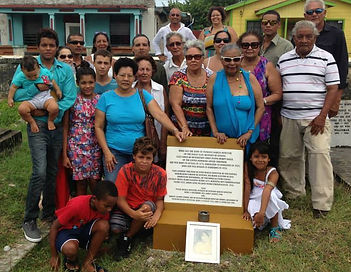
In 1925, following the collapse of her husband’s business interests, Marian emigrated with her six children to Barbados. All Lokono descendants in Barbados trace their ancestry to this family line. Marian died in 1928 and was buried at Westbury Cemetery in Bridgetown. Her grave is the only known burial site of a Lokono royal in the Caribbean and bears inscriptions in both English and the Lokono language.
Pakuri Village and Cultural Continuity
While the ruling family entered the diaspora, other members of the former chiefdom resettled along the Mahaica River, where Pakuri Village, also known as St. Cuthbert’s Mission, was established. Families from the Upper Demerara and Mahaicony regions, including the Simon brothers, formed the core of the new community.
Pakuri became the primary center for the preservation of the Lokono language and retained the last known traditional Bahi dedicated solely to ancestral animist spirituality. Despite missionary pressure, a small number of Lokono continued to practice traditional beliefs, often privately.

Reconnection of the Diaspora
In the 1960s, Marian’s son David Arnold DeWever attempted unsuccessfully to retain legal claim to the former Demerara Chiefdom lands. Contact between the diaspora and Pakuri was largely lost until 1992, when Marian’s great-grandson Damon Corrie married Shirling Simon, an Eagle Clan Lokono woman from Pakuri.
Four of their children were born on Pakuri Lokono territory, restoring direct living continuity between the diaspora descendants and the homeland community.
The Eagle Clan Lokono Today
As of 2025, Eagle Clan Lokono descendants number approximately one hundred in Barbados, one hundred and fifteen in the United Kingdom, eighty-five in Cuba, fifteen in the United States, and ten in Canada, with several hundred relatives residing on Pakuri Lokono territory in Guyana.
While many Lokono today are unaware of their detailed ancestral history due to generational knowledge loss, the lineage itself remains intact and documented.
Lokono Ancestral Cosmovision
Worldview, responsibility, and preservation
Traditional Lokono spirituality is animist in nature and is understood as an inherent way of relating to the world rather than a religion one converts to. Lokono belief recognizes a supreme, biologically genderless creative force, as well as observable masculine and feminine expressions of creation manifested through the sun, moon, and earth.
The Semichichi, or shaman, serves as an intermediary between the physical and spiritual worlds, assisting the community rather than ruling it. Sacred tobacco plays a central role in prayer, purification, and rites of passage, including puberty rituals and communal ceremonies held within the circular Bahi.
Cultural Ethics and Values
Lokono ancestral teachings emphasize generosity, truthfulness, bravery, compassion, gratitude, and respect for life. These values were understood as innate human knowledge rather than commandments imposed by external authority.
Preservation and Responsibility
This history is recorded to ensure that the knowledge, lineage, and cultural foundations of the Eagle Clan Lokono are not lost to time. It is preserved as a resource for descendants, researchers, and all those who seek to understand Lokono history with accuracy and respect.